

PROJECTS
One of our partners, founded on January 1st, 2008, is in Kunshan, Suzhou, Jiangsu Province, with a registered capital 7.15 Million USD. It's a subsidiary to a British-founded enterprise, headquater at Singapore. It mainly foucuses on the R&D and production on fields like industry, aerospace, medical equipment, and communication satellite power supply. In this case, we customized, according to their requirement, many kinds of external adapter wire harness connecting to the power outlet, which is shown below.

Numerically-Controlled Machine Tool Wire Harness Customization
For this project, the customer we served is one focusing on manufacturing PCB-Based numerically-controlled machine, the share of market of which reaches up to 30%. In fact, among all the wire harnesses it uses, most of them come from us Kable-X. Throughout the 10 years we've been cooperating with, we always keep the zero defect delivery record. What brings us to success is that we conduct strict control during the production, managing to reduce wastage and raise products pass rate as possibile. What's more, employees in our factory are of low quit rate, and together with high automation, we present our customers with quality products, timely service, and reasonable and competitive market price. We strictly perform the standard ISO9001 and IATF16949, with management principle "7S" conducted on site. Every single production line of us must be equipped with a patrolling QA member, ensuring that each processing technique is performed under the national standard IPC620.

Industrial Elevator Application Case
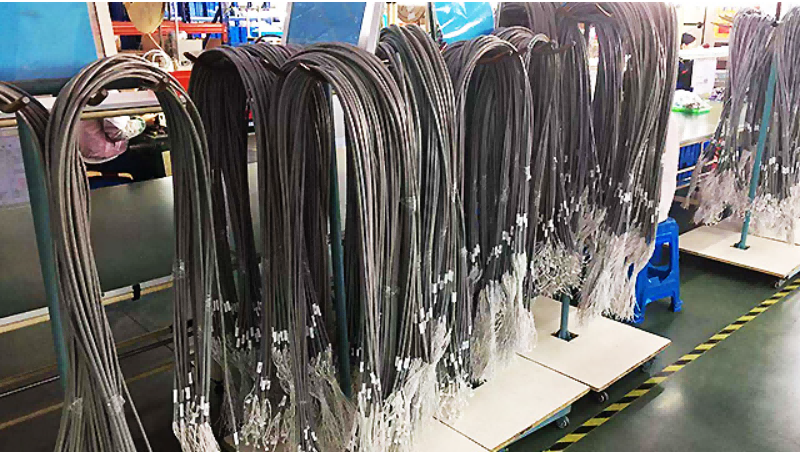
In this project, we served an Japan-funded enterprise located in Tianjin. It focuses on industrial elevator manufacturing and for many years, the wire harness they use are provided by us. Kable-X is a high-end wire harness customization factory as well as a certified high-tech enterprise, which has obtained over 20 industry patents successively through years.
Compared with that of other factories, wire harnesses produced by Kable-X are of higher bending-resistance and abrasion-resistance. And the production and quality management we conduct are always reassuring, for we always strictly perform the ISO 9001/IATF16949 standard, and equip each production line with a patrolling QA member who strictly conduct management and control under standard IPC620.
Role The Escalator Wire Harness Plays in The Operation of The Escalator

The escalator plays an important role in our daily life, no matter in the office building or in the residential building. The escalator goes up and down, working almost the entire day, which is quite a challenge to the escalator wire harness and the safety system of it. In recent years, we can learn from news that many casualties occurred on the escalator were caused by the aged escalator or its system malfunction.
The role the escalator wire harness plays in the escalator's stable operation is obvious. Then what requirement should be meet during the escalator wire harness processing? How to ensure the product quality? Let's see how we analyze it.
Structural Characteristics of Escalator wire Harness:
1. Use single-stranded 0.2mm round copper with the insulating layer between the insulation and the conductor. In this way, when the cable is bended along the same direction, it has more flexibility.
2. Hardened core, made up of nylon cord and steel wire rope, is added to the cable to undertake the mechanical tension and increase the extension strength of it.
3. Neoprene sleeve is used in YTF cable to improve its weather ability and flame retardancy.
The Requirement of Escalator Wire Harness:
1. The cable, before using, should hang freely and shrink as much as possible, with the hardened core fixed to undertake the pull together.
2. Cables, if there are many, should be set in rows, for during the operation of the escalator, it goes up and down, which requires high flexibility of the cable.
3. The cable should be placed vertically and of certain extension strength.
4. The cable should be flame retardant for its working environment is with oil.
5. The cable should be of small outer diameter and light weight.
Application Of 3D Printing Technology In Wire Harness Processing Industry
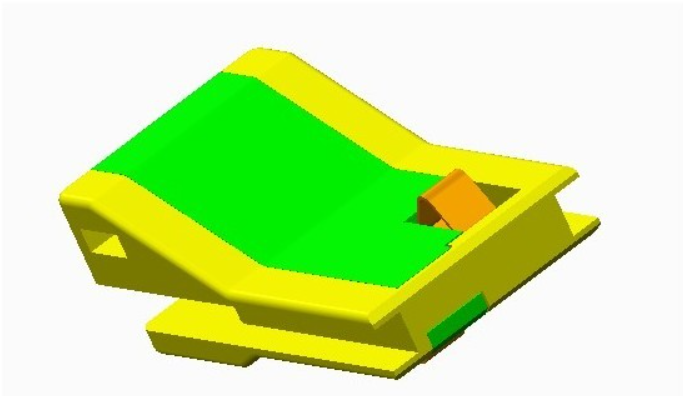
In the mid-1990s,a new production and manufacturing technology -3D printing technology was invented, with the rapid development of the 3D printing technology, now it can be applicated in my fields of our daily life, Kable-X, as a professional wire harness manufacturer, has also integrated the traditional methods of wire harness processing with 3D printing technology, perfectly use it in new product development, testing and validation stages. In several years ago, it's a bottleneck when a product complete 3D printing enters the mold opening stage, If the mold is not opened, the product model cannot be verify the feasibility and manufacturability of the product, if the mold is opened, it may face the risk of scrapping a set of molds when the product does not pass the acceptance inspection, it would a large amount of money. The most important is that the mold opening cycle is too long, it is very hard to finish in a very short time, a little product could cost 1-2 weeks, a big product could cost 3-4 weeks, even 5-6 weeks or longer, the emergence and application of 3D printing technology have perfectly solved this problem. After the 3D mold completed ,we can complete the product mold in 1-2 days and implement simulated assembly even complete function testing, which can shorten the mold opening cycle and save expensive mold costs.
Moreover, we have also applied 3D printing technology to the test phase of our developed products. Using 3D printing to manufacture testing fixtures has a shorter construction period, more flexible improvements, cost savings, and a stronger guarantee of product delivery qualification rate. It can be said to be a major technological reform that kills two birds with one stone. In recent years, Kabl-X has greatly shortened product development cycles and costs by utilizing 3D printing technology, received unanimous praise from a large number of customers, and more and more customers trust and rely on Kable-x's technical support and fast service in the early stage, further elevating Kable-x's position in the online beam processing industry. More and more customers actively seek Kable-x for communication and cooperation.

Wire Harness Mounted on Vehicle at the Customer's
Project of Air Conditioner WIRE HARNESS on EV
As for the vehicle-mounted air conditioner compressor on EV, Kable-X is always here, providing connection solution for partners! And what you see above is the customized air conditioner wire harness we made for one of our partners, a famous domestic vehicle air conditioner maker that we've cooperated with for so many years.
The reason why it chose us is that we got the great R&D ability, for we're equipped with a self R&D team of more than 10 people, developing new products over 30 annually and we've obtained 15 industry patents in succession. 7S Factory management is strictly implemented conforming to ISO9001 and IATF16949, with each production line equipped with a patrolling QA member and performing production techniques according to national standard IPC620.
Having high-technology and advanced production and test equipment, Kable-X Technology(Suzhou) Co., Ltd. has realized vertical integration on partial principal materials including wires, electrical units, hardwares and injection molding parts, by establishing complete quality control system special original parts sourcing channel.
What's more, we actively participate through the design and mold selection for the prototype to meet various requirements for our customers.

Energy-Storage Equipment Project
In this project, we serve a company, founded in 2012, focusing on providing solutions of advanced distributed photovoltaic products, energy-storage products and intelligent energy management.
What's shown in the picture above is the energy-storage cabinet at the customer's site, and the customer sincerely thanked us for our powerful connection ensurance.
The Correct Vehicle Wire Harness Connector Positioning and Identification Method

As the automotive industry develop fastly, people's requirement for the automobile is not limited to transport means, and they need more improvement in safety and comfort for it. For the time being, connectors have become as important as other mechanic components of the automotive industry. However, the increase in amount of connectors used for a whole vehicle brings great confusion for the wire harness designers, process decomposers, and processors. How to position the connector in a faster and more accurate way? Here in this article, we analyze deeply the accurate connector positioning way to ensure of more realiable positioning infomation.
Automotive wire harness is one of important parts of the vehicle, known as the automotive nerve, the carrier of the automotive electric signal. And the automotive connector is the most important of the wire harness, the key to realize realiable signal transmission inside the wire harness.
Here in this article, we're going to introduce the correct positioning and identification method of connectors from five aspects.
1. Connector Inversion
Inserted backbuckle is a specific locking gadget, designed to fix the wire harness and its inserting end. Generally, it's very easy to identify when the backbuckle is hooked up to the outside.
2. Connector Hole Positioning
The connector hole is an error prevention mechanism set up by the connector manufacturer to avoid wrong insertion of the connector. They put corresponding symbols like numbers or letters on the surface of the connector to define the insertion hole.
3. Wire Going out Direction Positioning
Wire going out direction positioning refers to confirming the connector direction from analyzing the wire harness direction at the connector end. Many ECU connectors are with back lid, and one can position the connector by analyzing the wiring route of the lid.
4. Connector Double Locking
The secondary lock of the connector is a locking gadget preventing the terminal falling off after inserting into the connector. At the meantime, the color of it is different from the connector faciliating identification.
5. Internal-Holed-Connector Positioning
The hole inside the connector is designed to carry different current for the connector. Hence, the connector manufacturer would design the holes into different shapes to facilitate positioning.
Truck Air Conditioning Project

In this project, we serve a Japan-funded enterprise, which was troubled by its former wire harness supplier for its poor quality. They found us on the website and established cooperation with us since then. We solved their quality problem, and optimized their former wire harness assembly scheme.
In the end, all wire harnesses produced by us were approved by its terminal customer WEBSTER, for we strictly conform to the IPC 620 standard during the production process and attach 100% importance to the quality.
Vehicle-Mounted Charging Cable

Delivering to its terminal customer, a Japan-based enterprise, in this project, we serve a Taiwan enterprise, which specializes in producing vehicle-mounted products. Wire harnesses for vehicle-mounted products require high quality and strict techniques, hence we specially developed many tools for it to ensure the quality. For a continuous three years, their terminal customers have never complained about any malfunction, which also accumulated us precious experience to enter the automotive field.
What's more, our customers never worry about our aftermarket service, for now we have sales and service sites in Taiwan, Hong Kong, Japan, Europe and etc, and we're going to set more in main economic bodies like south-east Asia, America and etc. in the future, aiming to reach the sales and service mechanism of in-time response within 1 hour.
A Brief Introduction to Automotive Wire Harness Production Technique by Kable-X

Kable-X Technology is a factory with a vibrant team focusing on R&D and production of high-end customized wire harnesses for industrial control, medical industry, automotive compressor, energy storage and etc. Today, we're going to introduce the technique of automotive wire harness connectors production. For the automotive circuit, the automotive wire harness serves as an internet main body. The automotive circuit wouldn't exist if there's no wire harness. How's the automotive wire harness been made then?
Generally speaking, it takes three techniques drawing, twist and wrapping to make a automotive wire harness.
With respect to its specific procedures, let's check them out together, shall we?
Firstly, we're going to talk about the wrapping. Based on the different functional conditions of wires and cables, exclusive equipment are used to cover with different material. The procedures include wrapping, vertical covering, squeezing and dip-coating and etc, of which the specific details go as follows:
Wrapping: mica strips, non-woven fabrics, belt-shaped paper, plastic bags and non-alkali glass fiber belts are used. And apart from them, fiber material like silk thread, cotton yarn and etc;
Vertical Covering: material like corrugated aluminum strip and rubber are used;
Squeezing: material like lead, plastic, rubber, aluminum and etc. are used;
Dip-Coating: material like insulating paint, asphalt and etc. are used.
Then, it's twist. The technique twist is usually divided into conductor twist, weaving, wrapping, cable-forming, wire-armouring and etc. To further improve the integration and flexibility, twining two wires or more towards direction required is called twist.
Finally, it comes to drawing. Drawing consists of single strand drawing and twist drawing. In pressure processing of metal, with the outside force, metal goes through the mold and its metal cross-section area tightly shrinks to achieve the required shape and size. Such processing is called metal drawing forming.

We cooperate with, in this project, an electronic technology company in Shanghai, which is a high technology corporate focusing on the technological development of medical equipment and aid device as well as the production and sales of them. After several months of R&D, we successfully replaced the OKI wire from Japan, for the medical flat panel detector project, and greatly reduce the cost of our customer with our competitive quality. And since then, we, Kable-X, have been the company's strategic supplier. We provide them with multiple varieties of customized wire harnesses with low MOQ, the sample delivered in 3 days and finished products in 2 weeks. And for those materials purchased from overseas, the sample will be delivered in 1 week and the finished prodcuts in 4 weeks. We manage to meet different customization requirement of our customer as possible with flexible service and quick response.
The Application of POGO PIN on Wire Harness

In recent years, as required by more and more products, the connection port design has started to replace the traditional leaf spring connector with POGO PIN. The latter is not only of small volume and great waterproof resistance, but can also carry large current, of which the leaf spring connector is not capable.
With regards to its application on the wire harness, one is to put the POGO PIN into the connector, for example the aerospace plug of military spec, which can greatly enhance the lifespan of the plug to over ten thousand times and lift the waterproof level up to IP68, however, the shortage is that the cost is a bit high.
The other is to combine the POGO PIN to the magnate, creating a new high-efficient port and realize quick attachment and detachment. Furthermore, the repulsion and attraction principle of the magnate can prevent erroneous insertion. Such thing is called the magnetic wire harness, the port of which is widely used in our daily life with common applications like wearing equipment, kid's smart watch and etc.
Nowadays, such wire harness with magnetic port is applied to more and more medical equipment. Nonetheless, the healthcare industry differs from the former two that it mostly adopts its own characteristic nonstandard design, which poses quite a bigger challenge to the integration development capacity of the wire harness supplier.
For the recent years, Kable-X has made integrated development on customized wire harness for multiple medical equipment clients. From pure charging to signal and electricity mixture, we've built our mature development workflow and gained many precious experience from the application of POGO PIN on wire harnesses.
Laboratory Equipment Application Case
In this project, we cooperated with a subsidiary corporation PALL of an American company Danaher, which focus on the R&D and production of laboratory equipment. Kable-X provides them with the wire harness for many of their testing equipment. PALL and Kable-X have maintained close and stable cooperation for over five years and it always highly praises us for our quality products.
We provide three-dimensional drawing for electronic components, injection molding parts, hardware parts and molds, that might be used in special wire harnesses and strictly conduct the management required by ISO9001, IATF16949.

IP Waterproof Level within the Wire Harness Industry

Within the wire harness industry, as regards the waterproof level, they're mostly measured by the waterproof and dustproof standard IEC 60529-2013, which translates to "Waterproof Level Provided by the Machine Shell(IP Code)" in Chinese. We often read expression like IP68 dustproof and waterproof standard though, what does the IP code exactly stand for?
Take code IP68 as an example: IP--International Protection Standard; 6-- Protection Level for the Solid; 8--Protection Level for the Liquid. What's below is the reference to each code.
The first number represents the protection level for the solid.
0 No Protection
1 Preventing Solid ≥50mm from Getting in
2 Preventing Solid ≥12.5mm from Getting in
3 Preventing Solid ≥2.5mm from Getting in
4 Preventing Solid ≥1.0mm from Getting in
5 Dustproof
6 Tight and Dustproof
The first number represents the protection level for the liquid.
0 No Protection
1 Counteracting the Impact from Drops Falling Down Vertically
2 Preventing Impact from Drops Falling at An Angle within 15 Degrees from The Vertical Direction
3 Counteracting the Impact from Spray-Like Drops Falling at An Angle of 60° from The Vertical Direction
4 Counteracting the Impact from Drops Splashed from Different Directions
5 Counteracting the Impact from Water Spurted out of the Jet from all Directions
6 Counteracting the Impact from Powerful Water Spurted out of the Jet from all Directions
7 The Performance not Affected and Without Leakage When Put into Water with The Top 0.15-1m from the Surface for a Continuous 30min
8 The Performance not Affected and Without Leakage When Put into Water with The Top 2-30m from the Surface for a Continuous 30min
Promotion and Application of IPC620 within the Wire Harness Industry

As a manufacturer focusing on wire harness, at its very beginning, Kable-X has already introduced into IPC/WHMA-A-620 as an important reference standard for production and inspection, only next to customers' specific requirements and related law and regulations. Throughout the time, we take it as a necessary training for newly hired education, specific position training and etc. Apart from that, we printed out the frequently-referred chapters and stuck them onto the wall, making sure that everyone can fully understand and make use of it. In the real practice, IPC620 is usually used to judge if the product is defective or can be released, which, on one hand, satisfies the customers, and on the other, greatly maximize the qualification rate and reduce the production cost. As a member of the IPC Association, the introduction of IPC/WHMA-A-620 show its capability of making continuous improvement on product quality and reliability, a strong recognition to Kable-X's ability within the wire harness industry.
At the beginning of 2020, the IPC Association issued its D Version Standard, and we participated in the training course launched in October domestically, to keep our training and application up to date, further enhancing the management level.
What to Pay Attention to When Using Connecting Terminals in the Wire Harness Processing?

Kable-X Technology(Suzhou) Co., Ltd. specially works on producing, processing and selling wire harnesses in various fields like industrial control, medical equipment, communication, military device and etc. We, in the daily wire harness processing, often deal with connecting terminals, an accessory product used to realize electrical connection and belongs to the industrial connector. With regards its utilization, a connecting terminal should meet the requirement of being conductive at the connecting part and not conductive at the insulation part. Here I am going to introduce how we prevent malfunction when using terminals. Generally, common malfunctions of terminals are 1. poor contact; 2. low insulation; 3. malfixation;
1. How to Prevent Poor Contact?
1) Conduction Test: Commonly, the connecting terminals producing factory wouldn't check the conduction when doing incoming material test, however the user, after mounting the wire harness, would do it to test if the wire harness works properly. And that's why we do conduction test on the incoming material to ensure of its performance.
2) Instantaneous Open Circuit Test: For some connecting terminals used in the dynamic vibration environment, test result that the contact resistance is qualified under the static circumstance, can't not make sure that the connection is still reliable in the dynamic environment. The truth is that instantaneous open circuit still occurs when some connectors of qualified contact resistance getting through simulated environmental test like impact. Considering that, we do dynamic vibration test on the connecting terminals required of high reliability.
2. How to prevent low insulation?
Insulation Material Test: In fact, the quality of the insulation material is of essential importance to the insulation performance of the insulator, hence the choosing of the raw material factory is very critical and one should never chase after cost reducing and thus ignore the quality. Consequently, it's necessary to choose materials from factory with good reputation, check and review the checking number and material qualification of each batch of incoming material, and make tracing document of the material utilization.
3. How to Prevent Malfixation?
1) Interchangeability Check: The interchangeability check is a dynamic inspection, which requires that plugs and sockets of the same series can be connected with each other to make sure that the insulator and contact components have no size deviation, and that the connectors can be mated, positioned and locked and won't get disintegrated under rotational force because components are missed or not assembled properly.
2) Conduction Test on the Crimped Wires: In some cases, core wires are found not crimped properly, or easily broken, leading to unreliable contact. What we get from analyzing such situation is that some assembling hole have blur or smudge on their thread, especially those had been electrically mounted onto the socket by the factory. The solution to it is unloading the crimped wires and change the socket. Furthermore, the infirm crimped end also arises from mismatching between the wire diameter and the crimping hole diameter, and improper crimping technique. To deal with that, we would do pulling test on the crimped wires.
Do You Really Understand Internet Wire Harness?

The Internet wire harness, also known as LAN CABLE, is a communication wire harness that every one involved in the wire harness industry is familiar with. How many standards and types do the LAN CABLE have then? Let's see.
1. Transmission Capability: nowadays the CAT.7 has a total 10 levels
CAT.1, of which the transmission frequency is 750kHZ, used as telephone wire, instead of data transmission
CAT.2, of which the transmission frequency is 1MHZ and the transmission speed 4Mbps
CAT.3, of which the transmission frequency is 16MHZ and the transmission speed 10Mbps
CAT.4, of which the transmission frequency is 20MHZ and the transmission speed 16Mbps
CAT.5, of which the transmission frequency is 100MHZ and the transmission speed 100Mbps
CAT.5E, of which the transmission frequency is 155MHZ and the transmission speed 1000Mbps
CAT.6, of which the transmission frequency is 250MHZ and the transmission speed 1Gbps
CAT.6A, of which the transmission frequency is 10Gbps
CAT.7, of which the transmission frequency is 600MHZ and the transmission speed 10Gbps
2. Product Structure:
Based on its shielding degree, mainly divided into UTP(unshield twist pair), FTP(foil twist pair) and SFTP(screen-foil twist pair).
3. Product Specifications: 3 main executive standard
USA TIA/EIA 568A(Commonly Used)
International Orgrnization: ISO/IEC 11801
Europe EN 50173
4. USA Registered Jack Wiring: mainly divided into two standards
568A: white and green, Green, white and orange, blue, white and blue, orange, white, brown
568B: white and orange, orange, white and green, blue, white and blue, green, white and brown, brown
5.Commonly Used RJ(Registered Jack)
Mainly include the following series: RJ9/10:4P4C RJ11:6P4C/6P2C RJ12:6P6C RJ45:8P8C RJ48:10P10C
6. UK RJ(also known as left-ear RJ)
It only has 6P, divide as 6P2C, 6P4C, 6P6C and is quite uncommon. Maybe you can check it out yourself in the British.
What to Pay Attention to When Processing Wire Harnesses

1. The length of wire harnesses processed: actually, the length of the wire harness under processing includes the whole length of the wire harness as well as the length of each branch and the length between each end of the wires.
2. The connectors involved in the wire harness processing: for a wire harness is composed by many wires, the connectors are used for connection between the wire harnesses, the branches and the electrical appliance. Therefore, it's necessary to mark on the connectors how many wires are used and where they are inserted. And what's more, the shape of the connector is also needed to be paid attention to for it's quite easy to mistake one for another when there're many of its kind.
3. The processing and component of the wire harness: the wire harness mounted on a vehicle is actually composed by many wire harnesses, divided as the main one and the branch ones. Hence it's a must to mark on the drawing the composition of each wire harness, which consist of many branches. And on each branch, the number, color and stripe of the wires need to be clear.
4. The mark and code of the wire connection: for the number of the electrical appliance mounted on a vehicle is quite large, to achieve correct wire connection, each joint should be with connecting mark and code to facilitate connection.
The Application Field of Waterproof Wire Harness

The quality of the processed wire harness is the life of an enterprise, which directly matters the rise and fall of it. We must be careful and responsible and pay every attention to each stage of the wire harness processing.
Kable-X Technology(Suzhou) Co., Ltd. is a strong factory specializing in wire harness processing and customization with a factory area over 3000 square meters and 150 professional wire harness processing equipment. We're capable of manufacturing wire harnesses for fields like industry, medical care, communication, automobile and etc., and have experience over 20 years on wire harness assembly and processing. Having professional technological talents, scientific and comprehensive management, strict production and test techniques and powerful factory supply chain, we meet the customers' requirements of trial production of small volume and customization production of large volume by reducing costs, enhancing products quality, flexible production and zero defective products. We provide free pre-sale design and customization scheme service and unconditional changing and refunding to provide satisfying products and service for our customers.
Today, I'm going to introduce the categories and features of the waterproof wire harness. Currently, the waterproof wire harness is mainly used in three fields: battery, automobile, waterproof electronic devices and etc.
With respect to the waterproof electronic devices, the waterproof wire harness is mainly used in: waterproof camera, waterproof video camera, waterproof electronic testers and etc. The automobile waterproof wire harness is mostly used to replace the normal ones for the auto-engine, the place near the chasis. While the battery waterproof wire harness is mainly adopted by the EV battery, cell phone battery, camera battery, storage battery and etc.
The waterproof wire harness features that, taking the EV battery wire harness as an example, preventing the wire harness from getting short circuit because of water permeation. The normal wire harness is used in many scenarios though, it has breakdown once it touches water, hence the waterproof wire harness is needed. The most important thing about the EV is the protection of its battery, and the waterproof wire harness can greatly prevent short circuit, thus to prevent the damage to the battery.
Contact Kable-X, if you need professional wire harness factory, one that adheres to the business ideology of "honesty, responsibility, innovation" and takes its pride in comprehensive after-market service aiming to jointly create a better future with our clients.
The Main Cause of Electronic Wire Harness Circuit Malfunction
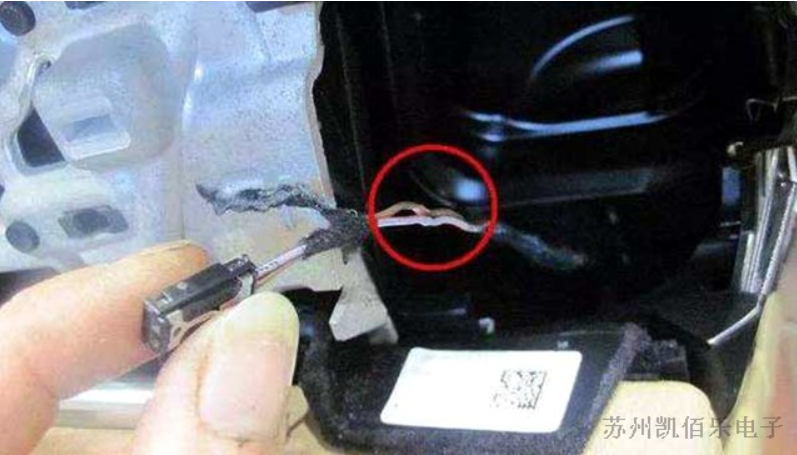
Currently, the application of electronic wire harness is very wide, but, no matter in which application scenario, if the electronic wire harness goes wry, it'll cause very severe consequences. Common seen malfunctions are: connecting parts with poor contact, short circuit of the wires, open circuit, bonding and etc.
The following aspects can cause the problem: 1) natural damage: the electronic wire harness exceeding the service life period; wire aging; insulating layer breaking; substantial decrease of mechanical strength; short circuit, open circuit, bonding of wires and etc.; electronic wire harness burning; wire harness terminal oxidation and deformation causing poor contact thus leading to malfunction of electrical equipment. 2) electronic wire harness damage causing electrical equipment malfunction: when malfunctions like overloading, short circuit, bonding occur on the electrical equipment, it'll cause damage to the electronic wire harness. 3) man-made malfunction: pressing against the electronic wire harness with metal objects, leading to electronic wire harness's insulating layer breakage, when assembling or troubleshooting automotive components; wrong connecting positioning of the electrical equipment wires; reversed connecting positioning of the storage battery positive and negative wires; random connecting and random cutting electronic wire harnesses when troubleshooting circuit. All these can cause malfunction of electrical equipment even burning the circuit. Therefore, a wire harness factory can never underestimate the short circuit of electronic wire harness and must do a job of prevention.
A New Method For Detecting Breakpoints In Harness

Specific method:
1.Connect one end of the wire harness (wire and cable) with a break point to the live line of 220V mains,the other end hangs in the air.
2.Switch the digital multimeter to AC2V gear,starting from the firewire access end of the harness (wire and cable,),hold the tip of the black watch pen with one hand, and move the red watch pen slowly along the insulation of the wire with the other hand, now, the voltage displayed on the display screen is about 0.445V (measured by the DT890D meter)
3.Move the red watch pen, when the red watch pen moves somewhere, the voltage on the display suddenly drops to a few volts of 0.0 (about a tenth of the original voltage).
4.About 15cm from this position forward (firewire access end) is where the harness (wire and cable) break point is.,. And experts warn, When we use this method to check the shielded wire,it can't be done if only the core is broken and the shield is not broken.
How To Test Terminal Tension Correctly
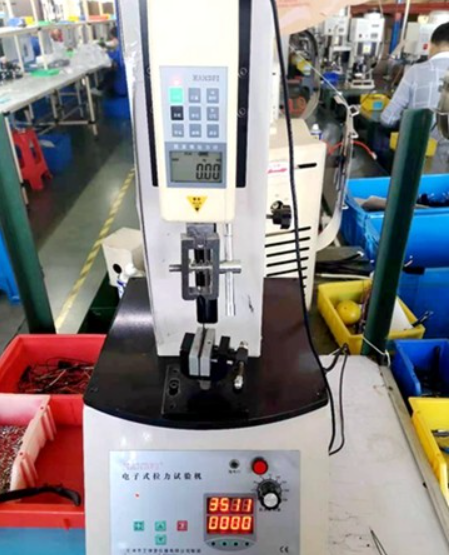
Kable-x Technology (Suzhou) Co., Ltd., has been engaged in R&D and production of high-end customized wiring harnesses for many years, which are widely used in the fields including industrial control, new energy, medical equipment, communication and so on. For our wire harness processing factory, we should insure the harnesses we produced are connected hardly with the terminals , and won't broke and detach under the specified tension. Below, Kable-x will explain you how to correctly test terminal tension.
First, when we need to prepare a testing wire, we should ensure the length of the testing wire is long enough to be placed on the tension test machine, it can't be too short. Then fix the terminal onto the clamping block on the tension machine and lock it tightly, but the clamp block cannot be fixed in the wire material crimping area, as this will cause inaccurate test values (usually fix the two-thirds of the terminal). Next, fix the wire onto the lower clamp block and ensure that it does not easily fall off, the lower clamp block would be designed for different types for different wires. After that, start testing and observe the machine values. The testing speed should not be too fast during testing. The speed of the testing machine is adjustable, and the tension speed is set to 25mm/min under normal conditions. At the end, by compared the test values with the standard values, can be determined whether the terminal tension meets the requirements, if not, we need to readjust the machine.
Introduction To The Differences In Standard Wiring Of Network Harnesses

In the production of network harnesses, there was a quality management personnel who asked me what is the difference between EIA/TIA T568B and EIA/TIA T568A, so Iwrite this article to describe the difference and production of this kind of harness.
The only difference of this two harnesses is the interchangeability of orange and green pairs, in a conventional network harness, all wires are directly connected, plug 4,5,7 are not used, because they are not actually needed for network data communication. The principle of network wiring harness is just as the picture shown below, TD represents the transmission, each with two lines (TD+ and TD-); RD stands for reception, and there are also two lines (RD+ and RD-).

Wiring harness manufacturers know that computers and other equipment generally communicate with each other through their respective sending and receiving ports, device A sends data to the receiving port of device B through the sending port, and device A receives data from the sending port of device B through the receiving port. The principle of computer network communication is also the same, when computer connect is connected to other computers through the hub, the matching between the sending port and the receiving port can be completed inside the hub, so the network cable between the computer and the hub uses a straight-through cable, the so-called straight-through cable refers to the sending port on both ends of the twisted pair is directly connected to the sending port, and the receiving port is directly connected to the receiving port; when the hub and the hub are cascaded through an ordinary port, it is similar to the communication of two separate devices, and must use a cross-over cable. The so-called cross-over cable means the sending port and receiving port on both ends of the twisted pair are cross-connected. Once we understand the above principle, it is not difficult to understand that when a hub or interactive machine itself has a cascading port, then cascading only needs to be connected with a straight-through cable, when two computers are connected directly instead of through a hub, a cross-over cable must be used.You can see that a cross-over cable is just a cable with one end connected to EIA/TIA T568A and the other end connected to EIA/TIA T568B. With this in mind, let's look at the steps for making our cross adapter: Plugs 4, 5, 7 and 8 are not used because they are not actually needed in network data communication.

Basic knowledge of selecting adhesive for wire harness product processing
Kable-X has been engaged in wire harness processing for more than 20 years, adhesive is commonly used in our daily processing. Today, I will introduce you to several kinds of adhesive that we often use in the wiring harness processing. Adhesive is an intermediate that connects two materials, often appearing as a water agent, and belongs to the fine chemical category. Common types include instant adhesives, epoxy resin adhesives, anaerobic adhesives, UV adhesives, hot melt adhesives, pressure-sensitive adhesives, latex adhesives, etc. I will introduce some commonly used adhesives in wire harness processing to help you purchase, store, and use adhesives correctly during the early development, production, and manufacturing processes.
1.AB Glue
AB glue is another name for two liquid mixed hardening glue, one liquid is the main glue and the other liquid is the hardening agent, only when the two liquids are mixed can they harden, and it does not need to be hardened by temperature, so it is one kind of room temperature hardening adhesive, generally used in industry. AB glue is also called two-component adhesive.
The use of AB glue:
Clean the adhesive at room temperature (25 ℃), then overlap adhesive A and adhesive B in a visual ratio of 1:1 or apply adhesive A to one of the bonded parts and adhesive B to the other, and then stick them together. After 2-3 break ins, fix for 5-10 minutes. The glue can reach 50% of its maximum strength after 30 minutes of bonding and reach its maximum strength after 24 hours. AB glue can be used in an environment of -60 ℃ -100 ℃. When using, do not mix a large amount of glue solution at once, and ensure good ventilation, there is an odor of acrylic ester in the adhesive solution, do not enter it, and do not cover the adhesive cap incorrectly after use.
Storage of AB glue:
AB glue generally has a shelf life of 6-8 months. If any component is found to precipitate during the shelf life, please mix it evenly before use or replace it.
Application of AB glue:
Generally used in processes such as wire beam processing for solder joint protection, PIN removal protection, stress relief, and assembly fixation.

2.UV Glue
UV glue is a type of adhesive that must be cured by exposure to ultraviolet light, it can not only be used as an adhesive, but also as a binder for paints, coatings, inks, etc. UV radiation is a segment of electromagnetic radiation that is invisible to the eye, with wavelengths ranging from 10 to 400nm. The curing principle of UV glue is that the photoinitiator in the UV cured material absorbs ultraviolet light and produces active free radicals or cations under the irradiation of ultraviolet light, triggering monomer polymerization and cross-linking chemical reactions, causing the adhesive to transform from liquid to solid within seconds.
Advantages of UV glue:
Environmental Protection/Safety
(1) No VOC volatile compounds, no pollution to the atmosphere.
(2) Adhesive ingredients are less restricted in environmental regulations;
(3) Solvent free, low flammability
Economy
(1) Fast curing speed, can be completed in seconds to tens of seconds, which is beneficial for automated production lines and improves labor productivity
(2) Once cured, it can be tested and transported, which can help us save the space.
(3) Can cure at room temperature, saving energy
(4) Only need lamps or conveyor belts to cure, can save space
(5) Single group sub-system, no need to mix, easy to use
Consistency:
(1) For temperature, solvent and moisture sensitive materials can be used
(2) Control curing, waiting time can be adjusted, curing degree can be adjusted
(3) Can be repeatedly applied and cured multiple times
(4) UV lights can be easily installed in exiting production lines without major modifications
Disadvantages of UV glue:
(1) High raw material costs, without low-cost solvents and fillers, high adhesive prices
(2) UV light has weak penetration through certain plastics or semi transparent materials, limited curing depth, and restricted geometric shape of curable products. Non transparent areas and blind spots that UV light cannot reach are difficult to cure.
(3) General UV glue can only bond transparent materials, and bonding opaque materials requires the use of other technologies, such as light delayed (cationic) curing, photothermal dual curing, light moisture dual curing, etc.
Storage of UV glue:
The normal storage condition for UV glue are an ambient temperature of 10 ° C to 25 ° C, located in a dry position in the original unopened container, once the container is opened, materials should kept in a dark environment, free of moisture, dust, high/low temperature, etc., but some customers used to keeping UV glue in -40℃~-18℃, which would cause some adhesive resins to crystallize, making them more difficult to handle.
Application of UV glue:
Usually used in processes such as wire harness processing for PIN removal protection and solder joint protection.

3.Instantaneous adhesive
Instantaneous adhesive is a synthetic adhesive mainly composed of cyanoacrylate ester, which is widely used in various industries due to its unique room temperature rapid curing without any additional auxiliary curing equipment. With the rapid development of technology, traditional 502 and other fast drying adhesives can no longer fully meet the requirements of the manufacturing industry.
Storage of instantaneous adhesive:
(1) Store in a cool and dry place, preferably refrigerated.
(2) If there is any unused glue after opening the lid, it needs to be completely sealed.
(3) Instantaneous adhesive has inflammability, need to stay away from the open flame.
Application of Instantaneous adhesive
Usually used in assembly adhesion reinforcement and wire clip adhesion reinforcement processes in wire harness processing.

4.Thread glue
Thread glue is a single component sealing adhesive made using the principle of oxygen inhibiting free radical polymerization, which can be used for both bonding and sealing. It does not solidify when in contact with oxygen or air, but quickly polymerizes into a cross-linked solid polymer once isolated from air, without the need for oxygen during use.
The use of thread glue:
Prevent loose threaded connections, if the screws are coated with anaerobic adhesive and assembled, a strong plastic film will be formed in the thread gap after curing, so that the screw lock will not loosen.Sealed and leak proof, no flat surface can be completely in close contact. Leak proof sealing is required, and thread glue can be used to fill the fitting gap. After curing, it is firm, durable, stable and reliable。
Storage of Thread glue:
Store in a cool place Do not store in high temperature, avoid direct sunlight, store for 12 months.
Application of thread glue:
Usually used in thread assembly anti-loosening and waterproof processes of wire harness processing.

5.Hot glue
Hot glue is a plastic adhesive whose physical state changes with temperature within a certain temperature range, while its chemical properties remain unchanged. It is non-toxic and odorless, and belongs to environmentally friendly chemical products. Due to its solid nature, the product is easy to package, transport, store, solvent-free, pollution-free, and non-toxic; And it is highly favored for its advantages such as simple production process, high added value, strong adhesive strength, and fast speed.
Storage of hot glue
It is better to keep in a dry and cool environment, and it is recommended that the storage temperature should not be higher than 30 degrees
Application of hot glue:
Hot glue is usually used in processes such as wire harness processing for PIN removal protection, solder joint protection, and testing fixture production. Compared to UV adhesive, the cost is lower, and more customers are willing to accept the use of heat shrink adhesive.

6.Epoxy resin sealant
Epoxy resin sealant can be cured at room temperature or by heating, with high hardness, smooth surface, and good gloss of the cured material. It has characteristics such as fixation, insulation, waterproofing, oil resistance, dust resistance, anti-theft, corrosion resistance, aging resistance, and cold and hot shock resistance. It is used for packaging electronic transformers, AC capacitors, negative ion generators, aquarium water pumps, ignition coils, electronic modules, LED modules, etc.
Storage and transportation of epoxy resin sealant:
This product is a non hazardous material, stored in a cool and dry place, and transported according to general chemical storage.
Application of epoxy resin sealant:
In the packaging of electronic components, the airtightness filling of waterproof connectors, and other processes.